




In today’s demanding cleaning environments from bustling shopping malls and hospital lobbies to transportation hubs surrounded by digital signage and high-value installations, facility managers face increasing pressure to maintain spotless floors with minimal operational disruption.
Among the various technical specifications of a scrubber-dryer, clean coverage stands out as one of the most crucial performance indicators. Yet, the clean coverage figure listed in product brochures often represents a theoretical maximum calculated simply from scrubbing width and maximum travel speed rather than what can actually be achieved in day-to-day cleaning.
To truly assess a scrubber-dryer’s efficiency, professionals must look beyond nominal numbers and consider a range of real-world factors: scrubbing width, squeegee width, operating speed, and runtime, as well as environmental constraints such as available cleaning time, obstacle density, aisle spacing, dead ends, and slope conditions. Only by integrating both the machine’s mechanical capabilities and its operating context can users accurately determine a scrubber dryer’s true productive value.
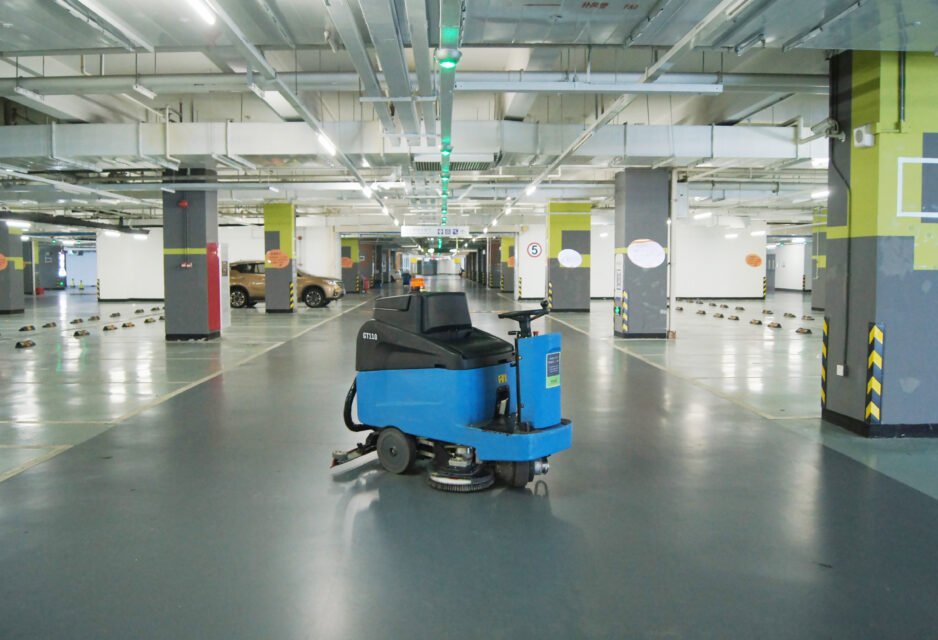
From working width to real-world passes: the foundation of coverage
The scrubbing width and squeegee width are the most fundamental mechanical parameters that determine a scrubber dryer’s cleaning footprint. Together, they define the area covered in a single pass. For example, a machine with a 500 mm scrubbing width will, in theory, clean 0.5 m² for every linear meter traveled.
However, in real-world environments, especially those with tight layouts, obstacles, or uneven flooring, theoretical width alone offers little insight into actual coverage. In highly obstructed areas such as facilities with multiple shelves, narrow aisles, or dead ends, a larger scrubbing width may actually hinder maneuverability. In contrast, a compact machine with a slightly narrower path may achieve higher real productivity by minimizing overlap and allowing smoother navigation through confined spaces. The design of the scrubbing system (disc or roller) and the squeegee configuration further influence effective cleaning coverage, particularly along edges and around obstructions.
Speed and the inverse relationship with cleaning quality
The operating speed of a scrubber-dryer directly affects its theoretical cleaning rate, but there exists a crucial trade-off between speed and cleaning quality. Operating at maximum speed may be acceptable for light maintenance, yet it drastically reduces dwell time, the period during which cleaning solution remains on the floor to break down soil and residues.
For deep cleaning in high-traffic areas, operators must often reduce speed to achieve satisfactory results, immediately lowering the effective m²/h output. Additionally, external layout factors, such as the available cleaning time per shift, narrow passages, and obstacles that require frequent turns—further influence actual speed. Power type also plays a role: battery models provide greater freedom for large open spaces but are constrained by charge levels, while cable versions ensure steady power yet limit mobility.
Runtime and the cycle of interruption: capacity’s crucial role
A machine’s running time defines its uninterrupted productivity. Runtime depends largely on battery autonomy (for cordless models) and the capacity of solution and recovery tanks. Each interruption whether to refill, empty, or recharge that subtracts directly from cleaning time.
External conditions such as distance to water sources, available cleaning window, and even floor gradients can extend these non-productive intervals. Machines with larger tanks and optimized layouts can therefore sustain higher real-world coverage over an operational shift. Managing runtime efficiently through quick refilling, proper maintenance, and post-use rinsing of the recovery tank that maximizes both cleaning performance and machine longevity.
Incorporating practical and environmental variables
While scrubbing width, squeegee width, speed, and runtime form the technical foundation of productivity, true cleaning efficiency also depends on environmental and operational variables. To transition from theoretical output to realistic performance, the following must be considered:
- Available cleaning time per shift/day
- Minimum aisle width and clearance
- Presence of dead ends or confined zones
- Distance between shelves or obstacles
- Maximum floor gradient (%)
- Frequency of maintenance tasks such as cleaning filters and replacing squeegee blades
By accounting for these real-world constraints, professionals can obtain a far more accurate m²/h measure that reflects sustained productivity rather than laboratory conditions. This realistic approach ensures that cleaning performance aligns with operational demands, facility layouts, and long-term efficiency goals.
 English
 Chinese
 German
 French
 Spanish
 Japanese